

Blog
Siah-Bazi: A Comic Gem of Iranian Traditional Theatre

Siah-Bazi: A Comic Gem of Iranian Traditional Theatre by Voda 24
Introduction
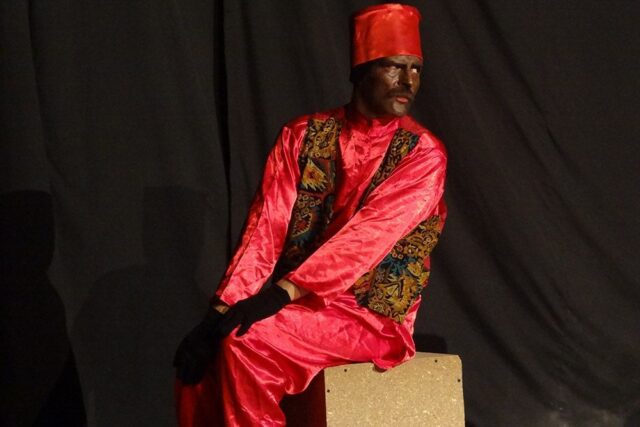
Siah-Bazi is a type of Iranian traditional theatre that combines comedy, dance, music, and song. In this lively performance, a master and his black servant — who is often portrayed as naive yet witty — engage in humorous and exaggerated actions that entertain the audience. The term Siah-Bazi has also evolved metaphorically in Persian, referring to any preplanned trick or deceptive act.
Beyond its humor, Siah-Bazi serves as a satirical lens through which social, emotional, political, and even historical themes are explored. It reflects the deep-rooted cultural tradition of using laughter as a tool for criticism and reflection in Iranian traditional theatre.
Siah-Bazi and Rouhozi: Two Different Forms
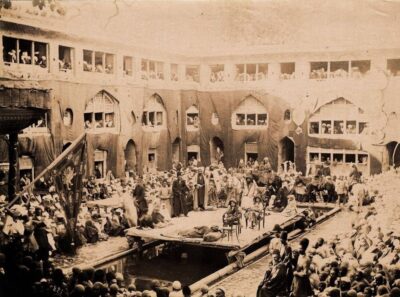
It is important to distinguish between Siah-Bazi and Rouhozi (or Takht-e Hoz). While they are both comic performances within Iranian traditional theatre, they are not identical.
In old Iranian houses, a large pond (Hoz) was often built in the middle of the courtyard. During celebrations or gatherings, residents would place a wooden platform over the pond to create a makeshift stage. Actors performed short comic plays on this platform, often featuring the popular character “Siah” — the black-faced clown.
Because of this character’s presence, these shows became widely known as Siah-Bazi, Takht-e Hoz, or Rouhozi. Although similar in setting, Siah-Bazi emphasizes witty dialogues, satire, and social commentary more than the physical humor of Rouhozi.
Decline and Prominent Artists
Today, Rouhozi and Siah-Bazi, once the heart of Iranian traditional theatre, are fading art forms. Modernization and changing entertainment tastes have pushed them toward extinction.
However, several renowned artists have kept the spirit of this genre alive — including Sa’di Afshar, Ata Saffarpour, Majid Afshar, and Javad Ensafi. Among them, Sa’di Afshar is often remembered as the last great Siah-Bazi performer, symbolizing the end of an era in Iranian traditional theatre.
Historical Background
The roots of Siah-Bazi lie deep within Persian rituals and festivals such as Nowruz, where humor and satire were integral to celebration.
This form of Iranian traditional theatre is believed to have originated during the Safavid dynasty and reached its peak around 1916 CE (1295 Solar Hijri). The performance evolved from folk traditions and gradually developed into a more structured form of popular entertainment.
Sa’di Afshar, as mentioned, is often regarded as the last surviving master of this ancient performing art.
Purpose and Meaning
Although Siah-Bazi is filled with joy and laughter, its purpose goes far beyond mere amusement. As part of Iranian traditional theatre, it embodies the voice of the common people — the masses who use humor to challenge authority.
The servant “Siah,” through his clever remarks and playful sarcasm, mocks social hierarchy and exposes the flaws of the elite, even kings and ministers. This inversion of power — a simple servant outsmarting his master — reflects the Iranian people’s desire for justice, equality, and freedom of speech through art.
Thus, Siah-Bazi is not only a form of entertainment but also a subtle act of resistance, laughter being the tool of truth.
Structure and Style
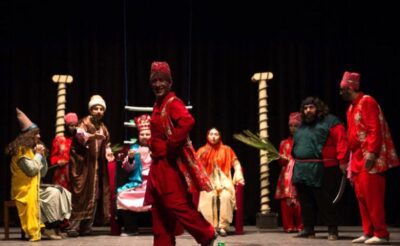
The structure of Siah-Bazi is simple yet rich in creativity. Typically, two main characters appear on stage:
-
Hajji (the master or governor), symbolizing authority and the ruling class.
-
Siah (also called Mobarak), the servant representing the oppressed, ordinary people.
The humor arises from the dynamic between these two. Siah, with his quick wit and improvisation, constantly ridicules his master and his companions. Through jokes, songs, and spontaneous lines, he criticizes society’s injustices and hypocrisies.
Improvisation (Badiheh-Sazi) is the central technique in Siah-Bazi. The actors often perform without a strict script, relying on timing, wordplay, and audience interaction. Music, dance, and cheerful songs enhance the rhythm of the performance, while the story usually ends on a positive note — often with a moral conclusion or reconciliation.
This mixture of humor, improvisation, and moral insight gives Siah-Bazi its distinctive charm and marks it as a cornerstone of Iranian traditional theatre.
The Art of the Siah’s Dance and Vocal Mastery in Iranian Traditional Theatre
One of the most remarkable and defining moments in Siah-Bazi—a central form of Iranian traditional theatre—is the Siah’s dance performed at the end of the play. During this final scene, the actor portraying Siah presents a dance that is entirely his own, a signature performance that reflects years of dedication, training, and personal creativity.
The art of Siah-Bazi is, in truth, one of the most demanding disciplines within Iranian traditional theatre. It requires not only a sharp sense of humor and comic intuition but also deep mastery of Persian musical modes (dastgahs) and traditional vocal techniques intricately woven into the structure of Iranian performances. Achieving true expertise in this art often takes many years—sometimes a lifetime—of relentless practice and cultural immersion.
A shining example of this musical and theatrical sophistication can be found in Master Ali Nassirian’s performance in the play Bongāh-e Teatrāl (The Theatrical Agency). In this piece, he performs a song in the Segāh mode—one of the most complex and expressive systems in Persian classical music. Mastering Segāh demands exceptional vocal control, emotional depth, and sensitivity to improvisation. Yet this is just a glimpse into the vast ocean of Persian music, which contains hundreds of unique melodies and improvisational forms, all performed live and without rehearsal.
Actors who play Siah rarely take on other roles once they don the symbolic black costume. The path to becoming a Siah—and remaining a good one—is so rigorous and consuming that little time is left for other genres of acting. To embody the role fully, every Siah actor must create a personal dance at the very beginning of his career. This dance becomes a lifelong artistic signature, remaining unchanged throughout his journey and eventually becoming instantly recognizable to his admirers.
These dances often draw inspiration from diverse artistic and regional traditions. For instance, one well-known Siah dance style is called “Shekasteh”—literally meaning “broken.” In this form, the Siah moves like a delicate puppet, reminiscent of Kheimeh Shab-Bazi (Iranian marionette theatre). Other performers prefer to merge their dance with folk styles from their own hometowns, blending regional rhythm and movement into their performance.
A striking example of this individuality can be seen in the dance of Master Asghar Zibaei-Nejad, whose graceful and fluid movements radiate serenity and natural harmony. His dance, shaped by his calm disposition, perfectly illustrates how the Siah’s final dance is not merely a performance—it is an intimate reflection of personality, mastery, and the living spirit of Iranian traditional theatre.
Conclusion
Siah-Bazi remains one of the most vibrant and expressive forms of Iranian traditional theatre. Though it faces decline in the modern era, its influence can still be seen in contemporary Iranian comedy, cinema, and social satire.
By blending laughter with critique, and simplicity with wisdom, Siah-Bazi continues to remind audiences that humor has always been a powerful mirror reflecting the truth of society.